What Would a Paleontologist Most Likely Do to Determine if a Fossil Represents a Reptile or a Mammal
Abstract
Mesosaurs are lizard-like reptiles that lived at the first of the Permian Period (280–290 million years ago) or fifty-fifty earlier. Mesosaurs are known from thousands of skeletons recovered in Uruguay, Brazil, and Southern Africa, including immature and adult individuals and even an embryo and a pregnant female. For years, mesosaurs have been considered aquatic (water-living) animals, because they have several characteristics of species that are adapted to an aquatic life, like webbed hands and anxiety and the presence of thickened and meaty bones. Withal, mesosaurs also share several features with terrestrial (state-living) species, such equally the structure of the hips, the limbs, and the heels. To figure out whether mesosaurs are really aquatic or terrestrial, we studied vertebral columns (backbones) of Mesosaurus and compared them to those of other aquatic and terrestrial animals. Studying the variations in the length of the vertebrae tin can reveal how the animals moved and whether they were adjusted to terrestrial or aquatic environments. Surprisingly, we found that Mesosaurus is more similar to terrestrial animals, which changes our ideas about their lifestyle.
What Were the Mesosaurs?
During early Permian times (280–290 million years ago), life on state included several amphibians and lizard-like animals that were the ancestors of all the dinosaurs, reptiles, and mammals. Mesosaurus was a cadger-like animal that lived in South America and Africa during the Permian Flow . Mesosaurus is considered one of the earliest aquatic relatives of reptiles and mammals [one]. The word Mesosaurus is Latin, and "meso" means "middle." Scientists describing the starting time Mesosaurus fossils believed mesosaurs were "in the middle" betwixt amphibians and reptiles, because they had features of both. Mesosaurs had several features that suggested they lived an aquatic lifestyle: a lateral compressed tail, webbed hands and feet, and nostrils placed close to the eyes in a high position (which immune breathing without lifting the whole head out of the water, like crocodiles do). Also, like manatees and plesiosaurs, mesosaurs had dense, thick bones that may take provided enable them to dive effortlessly in h2o (Effigy 1). Considering of all these characteristics, mesosaurs were considered fully aquatic and scientists believed that they rarely, if ever, came out of the water. All the same, mesosaurs as well had sure features that were more similar to terrestrial animals, like the structure of the hip and heel [two]. Besides, the environment in which mesosaurs lived was believed to have been very shallow water that was drying and shrinking, like what is happening today to the Aral Body of water or Urmia Lake. Then, in order to tell for certain whether mesosaurs were aquatic or terrestrial, we studied patterns in vertebral columns (backbones) and limbs (arms and legs) of mesosaurs, to see what nosotros could decide about their lifestyle and to investigate only how aquatic they were.
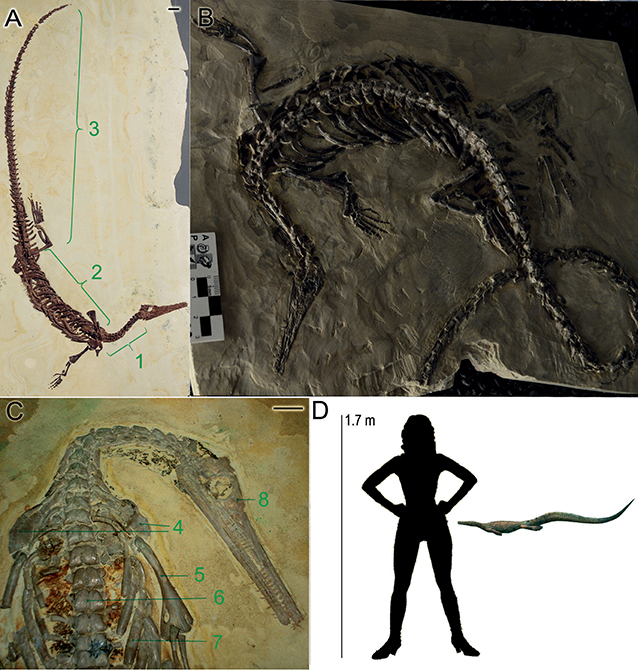
- Figure one - (A–C) Some mesosaur skeletons with various parts labeled: one. cervical region, two. dorsal region, 3. caudal region, 4. shoulder blade, 5. humerus, six. vertebral cavalcade, seven. ribs, 8. skull.
- (D) A scaled effigy showing the average size of Mesosaurus.
Many Aquatic Animals Use Undulation to Swim
Most aquatic and semi-aquatic animals swim by moving their bodies or tails side to side, or up and down. This wave-similar move is called undulation and it is used by reptiles, whales, and fish. A few exceptions exist: turtles and penguins are aquatic animals that swim by repeatedly moving their paddles (this movement is chosen oscillatory motion or flapping) Animals like seals, walruses, and plesiosaurs swim using a combination of the movements of their paddles, tails, and bodies, combining undulation and oscillation movements.
Animals that undulate practice not simply move their tails side-to-side or up and down to swim. Undulatory swimming involves movement of the whole body, because the wave-like move passes along well-nigh of the vertebral column in order to reach the tail (Figure 2). Animals that swim with an undulatory move have some features of their vertebral columns that allow them to brand undulations of the appropriate size. For example, certain regions of the vertebral column may be reinforced, stiffened, elongated, or shortened, depending on the species.
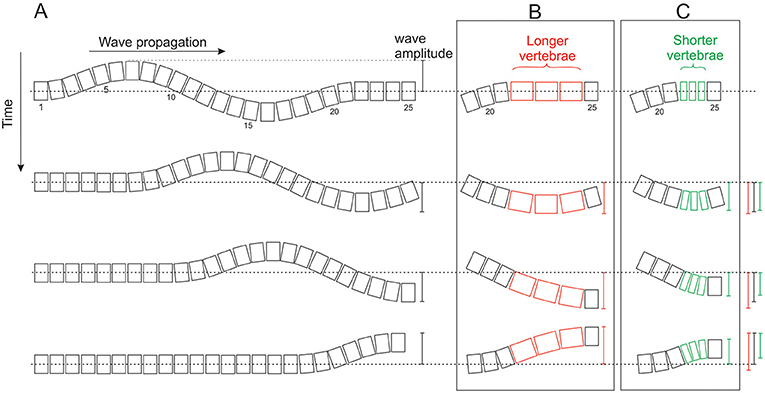
- Figure 2 - (A) How an undulation travels along the vertebral cavalcade when all vertebrae are the aforementioned length.
- The vertebrae are numbered from 1 to 25, with 1 being the first cervical (cervix) vertebra. Yous can encounter that the wave maintains its size and shape along the vertebral column. (B) The amplitude (height) of the undulation increases when three vertebrae are longer than the balance. (C) The amplitude of the undulation is reduced when 3 vertebrae are shorter than the rest and the segments become more than rigid. Note that the bending between the vertebrae is the same, the only difference is the segment length. Source: https://doi.org/10.3389/fevo.2018.00109.
If all the vertebrae are similar in length, the undulations will pass through the whole backbone in a like fashion, from trunk to tail tip, without showing changes (Figure 2A). In contrast, differences in the lengths of certain vertebrae can produce changes in the undulations as they move forth the spinal cavalcade. When an undulation passes through the body, each vertebra transmits the movement to the side by side ane. If 1 vertebra is longer than the i before it, the size of the (horizontal) undulations increases in that area (Figure 2B). Similarly, if i vertebra is shorter than the one earlier it, a reduction in the size is produced, (Figure 2C). Over many generations, animals conform by shortening their vertebrae in the areas where more rigidity and stability are needed or lengthening them where flexibility and enhanced mobility are needed.
It is expected that the vertebrae of aquatic and semi-aquatic animals should be longer in certain areas of their tails. In other areas, vertebrae should have a abiding length, considering these areas of the backbone allow the animals to generate and maintain broad undulations to propel themselves forward.
Terrestrial animals also undulate their vertebral columns while they walk. Even so, terrestrial animals need more than mobility in their trunk regions, and then the vertebrae in the trunk region are the biggest ones, not the vertebrae of the tail like in aquatic animals.
A Study of Skeletons: Were Mesosaurs Really Aquatic?
We examined 40 mesosaur skeletons, from museums of Uruguay, Brazil, France, Deutschland, Poland, Switzerland, and the United states of america. Some fossils were preserved as petrified bones; others were preserved equally molds or casts in rock. We measured the length of each vertebra using high-resolution photographs (similar in Effigy one), and we plotted the information to see how length changes forth the body. Data from other extinct semiaquatic and terrestrial animals were likewise included in our study. Nosotros measured the vertebrae of other related extinct species and we collected data from other previously described animals from the literature. Then, we compared the data for Mesosaurus with the data from other semiaquatic and terrestrial animals. Some species that still exist were too studied, like crocodiles and iguanas, because these animals accept semiaquatic lifestyles like to mesosaurs. The extinct species were selected because they were of a like geological age (from the Carboniferous or the Permian periods).
Considering adult animals are larger than young members of the same species, comparison their data can be catchy. To solve this problem, we used a type of math called statistics to make the information for unlike sized individuals more than valid.
We also compared, when the information was available, the relative sizes of the hind limb bones, which are unlike in terrestrial and aquatic animals (run into Núñez Demarco et al. [3]).
Maybe Mesosaurs Were Only Semiaquatic!
We saw 2 patterns of vertebrae sizes; one for terrestrial and one for semiaquatic lifestyles (see Figure 3).
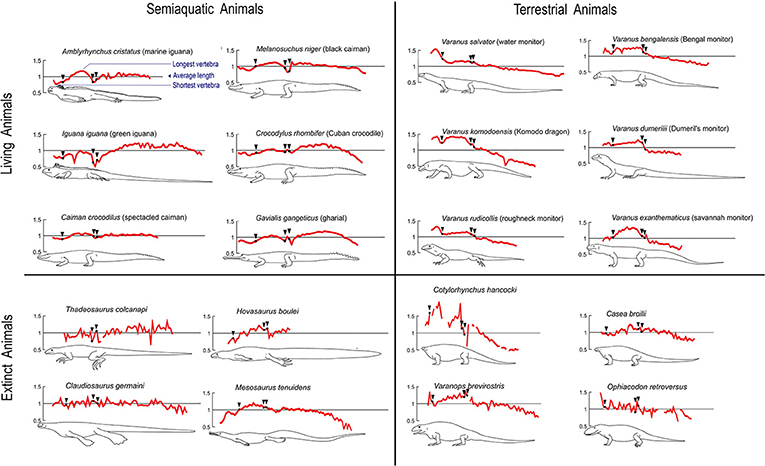
- Figure 3 - Vertebral length profiles for different species of semi-aquatic and terrestrial extinct and living animals related to mesosaurs.
- The information was created using statistical methods, then the y-axis shows the variation in length with respect to the average vertebral length. For example, a value of one.five means that the vertebra is i.5 times the boilerplate. Black arrows mark the areas where the neck ends and the breast begins, and where the trunk ends and the tail begins. From this data, you can see that the vertebral length decreases continuously in the tails of terrestrial animals, but it increases or maintains its length in the tails of semiaquatic animals. Source: https://doi.org/10.3389/fevo.2018.00109.
A. In terrestrial animals, the cervical (neck) vertebrae are longer than caudal (tail) vertebrae and in some cases tin can exist even longer than the dorsal (trunk) vertebrae. The dorsal vertebrae are longer than the average, and the dorsal region of the spine displays either a peak in vertebral length or has a central region in which the dorsal vertebral length is almost constant. In some species, dorsal vertebrae are the longest ones. Caudal vertebrae decrease in length almost constantly toward the tip of the tail.
B. In semiaquatic animals, cervical vertebrae are not the longest ones; they are shorter than, or similar in size to, the caudal vertebrae. The dorsal vertebrae take a design that is similar to that of terrestrial animals, only the dorsal vertebrae are sometimes shorter than the average. Caudal vertebrae are sometimes the longest ones and, unlike in terrestrial animals, the caudal vertebrae increase in length or keep their length constant along virtually half of the tail.
Intriguingly, Mesosaurus has an intermediate blueprint. Its cervical vertebrae are short, equally in semiaquatic animals, except for four or five vertebrae in the heart of the neck observed in some individuals. Even so, Mesosaurus'southward caudal vertebrae take a pattern that is in between the terrestrial and semiaquatic patterns. This result is surprising, because for many years was believed that mesosaurs were aquatic, merely their patterns somehow resemble those of terrestrial animals, which suggests a semiaquatic lifestyle, living partly on land and partly in the water (meet Figure 4).
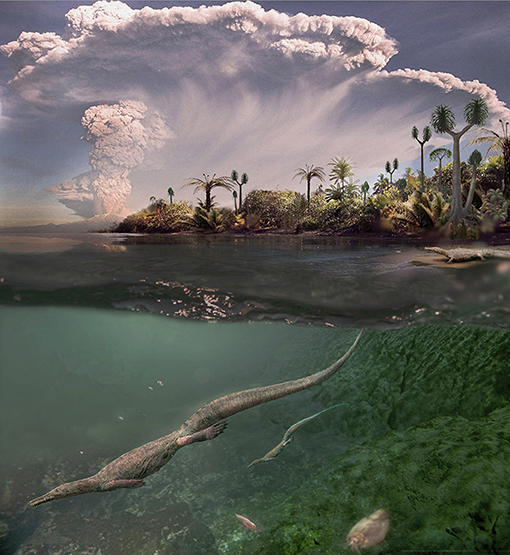
- Figure four - Reconstruction of mesosaurs in their harsh environment 280 million years ago, showing closely placed volcanoes spreading ashes over the salt-h2o lake where they lived.
- You can see the probable food of mesosaurs, the pygocephalomorph crustaceans, below to the right. Note that following the results obtained in this study, Mesosaurus specimens are shown swimming in the lake and also walking on the ground. Credit: Roman Yevseyev, Pablo Núñez Demarco and Graciela Piñeiro.
Why This Is Important?
Some previous studies suggested that mesosaurs laid eggs on land [4]. Thus, they could exist the first known animals that laid their eggs on land. Even so, that theory was non universally accepted, considering it was thought that mesosaurs hardly e'er went ashore. Nevertheless, our written report showed that mesosaurs could motion on country, just every bit crocodiles do! This testify will help us to understand much more about the evolution of mesosaurs and the possible causes of their eventual extinction, and might also lead us to question our ideas about other aboriginal species that we currently believe to be specially adapted to a particular environs.
Glossary
Permian Period: ↑ The final geological period of the Paleozoic Era, extending from 299 to 251 million years before nowadays.
Undulation: ↑ Moving ridge-like motility.
Oscillation: ↑ Repeated movement. When talking about forms of swimming, it usually refers to flapping.
Semiaquatic: ↑ Partially aquatic animals living or growing partly on land and partly in h2o or spending considerable amount of fourth dimension in water. Usually, such animals live in or well-nigh h2o bodies, such equally rivers, lakes or seas.
Cervical: ↑ Pertaining to the neck of an creature'southward body.
Caudal: ↑ Designates the tail or its area, the posterior part of an animal's body.
Dorsal: ↑ Related to the back of an animal's body.
Disharmonize of Involvement Statement
The authors declare that the research was conducted in the absence of any commercial or fiscal relationships that could be construed as a potential conflict of interest.
Original Source Article
↑ Núñez Demarco, P., Meneghel, M., Laurin, K., and Piñeiro, M. 2018. Was Mesosaurus a fully aquatic reptile? Front end. Earth Sci. half-dozen:109. doi: x.3389/fevo.2018.00109
References
[1] ↑ Laurin, Grand., and Piñeiro, Yard. 2017. A reassessment of the taxonomic position of mesosaurs, and a surprising phylogeny of early amniotes. Front. Earth Sci. 5:88. doi: ten.3389/feart.2017.00088
[ii] ↑ Romer, A. S. 1956. The Osteology of the Reptiles. Chicago, IL: University of Chicago Press. p. 772.
[3] ↑ Núñez Demarco, P., Meneghel, One thousand., Laurin, Thousand., and Piñeiro, G. 2018. Was Mesosaurus a fully aquatic reptile? Front. Earth Sci. six:109. doi: ten.3389/fevo.2018.00109
[iv] ↑ Piñeiro, G., Ferigolo, J., Meneghel, 1000., and Laurin, Grand. 2012. The oldest known amniotic embryos suggest viviparity in mesosaurs. Hist. Biol. 24:620–thirty. doi: 10.1080/08912963.2012.662230
schwartzonsed1952.blogspot.com
Source: https://www.frontiersin.org/articles/427776
0 Response to "What Would a Paleontologist Most Likely Do to Determine if a Fossil Represents a Reptile or a Mammal"
Postar um comentário